
One Vehicle, One Story: The Vinot & Deguingand Omnibus, the ‘teuf-teuf’ that survived the Great War
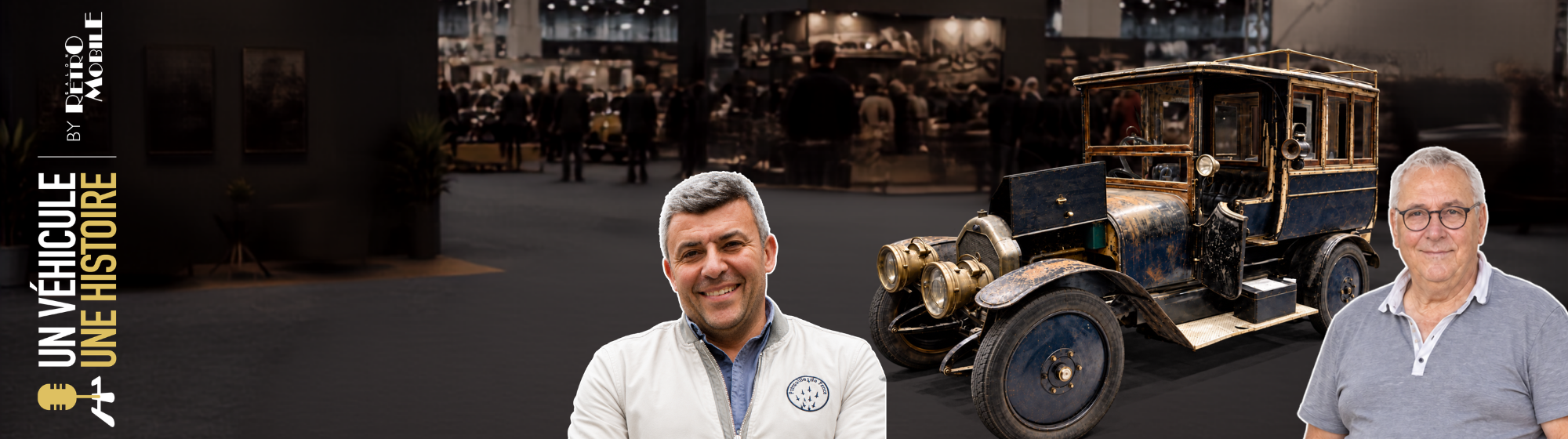
Vinot and Deguingand 1913: before the war, before everything
Some objects pass through history without ever losing their way. The Omnibus Vinot & Deguingand, exhibited on the Club des Teuf-Teuf stand at Rétromobile 2026, is one of them.
1913. The date arrives with all the weight it carries: we are one year away from the outbreak of the First World War, in a Europe living through its last months of relative innocence, and in a France where the automobile is still a daily adventure, as much a mechanical challenge as a promise of modernity.
In Nanterre, at the Vinot & Deguingand workshops, cars have been built since 1901. The marque was part of that extraordinary industrial ferment that made the western suburbs of Paris one of the cradles of the French automobile. Panhard, De Dion-Bouton, Mors, Vinot: dozens of manufacturers were competing for a nascent market. In 1913, the vehicle that was not yet quite an omnibus rolled out of their workshops. The machine was accomplished: a 2.4-litre 4-cylinder engine, a 4-speed gearbox with reverse, shaft drive, without a chain. An architecture that Sylvain Deshayes notes himself, with some amusement: "The conventional mechanics of today haven't really evolved." A century on, the basic principles remain identical.
Omnibus Vinot & Deguingand: from the front line to the thermal spa
The story of this omnibus begins in uniform. A military registration number found under the bonnet, a colour that gives nothing away: the vehicle left the factory in 1913 with a military assignment, in a France that, without yet knowing it, was preparing for total war. What bodywork did it carry then? Sylvain Deshayes does not know. History did not record it.
What history did record, however, is what came next. In 1920, the vehicle returned to the Vinot & Deguingand factory in Nanterre, its original manufacturer. There it was modernised: new radiator, conversion to electric ignition, reconfiguration as a passenger omnibus. It left equipped for a new life, radically different from its first. Its destination: Lamalou-les-Bains, a thermal spa town in the Hérault, where a grand hotel acquired it to ferry guests between the railway station and the establishment. For decades, this machine that may once have skirted the trenches now drove patients taking the waters along the peaceful roads of the Languedoc.
Then came 1970. The hotel sold the vehicle. A German dealer bought it and took it across the Rhine. And there, for years, the omnibus slept under a tarpaulin in a courtyard, exposed to the elements, letting time and moisture work on the bodywork. "In a way, I think that's what gives it its charm," says Sylvain Deshayes, with the quiet philosophy of someone who knows how to recognise the authentic patina of genuine preservation. The tarpaulin caused damage. It also protected. That ambiguity, precisely, is what gives pre-war cars their particular flavour.
Omnibus Vinot & Deguingand: a transmission, not a transaction
When the omnibus returned to France, it came via an elderly foreign gentleman, forced to return to his home country and clear his garage. He could have called a dealer. He could have put it through an auction. He did neither. "He approached me very kindly, saying: I know you'll make good use of it, I know it won't end up in a dealer's hands. He wanted the car to keep living. He wanted to pass it on to someone who would know what they had."
That sentence sums up everything the world of pre-war cars represents at its finest: it is not a market, it is a community. And in this community, cars are not sold: they are entrusted. To someone worthy, knowledgeable, and passionate. Sylvain Deshayes was that person. He knew it, the previous owner knew it, and the car, in its own way, knew it too.
Club des Teuf-Teuf: three generations sharing the same passion for the historic automobile
Sylvain Deshayes did not arrive at this passion by chance. He received it. His father was already a member of the Club des Teuf-Teuf, that legendary club devoted to automobiles built before 1914, present at Rétromobile since the very first edition. For several decades, Sylvain has followed in his father's footsteps, now accompanied by his son, who has also joined the club in turn. "It truly is a transmission from father to son to grandson," he says, with undisguised pride. Behind that phrase lies a collection: around twenty vehicles built before 1920, gathered across the generations in a garage in Normandy, and presented to the public every year at the Journées du Patrimoine.
"For 19 years I have opened the garage. We have 400 to 500 people every year, and yet we are in a small village of 1,000 inhabitants in the depths of the Manche." The fascination with pre-war cars knows no geographical boundaries. It crosses generations, social backgrounds, ages. And when a 1913 omnibus appears in a Norman courtyard, eyes widen, whether you are 8 or 80.
The Club des Teuf-Teuf has been at Rétromobile since the salon's very beginnings. At each edition, its members bring the outdoor areas of the event to life with their cars in motion, giving rides to visitors. On this particular day, it is a group of children with disabilities who are discovering the world of the historic automobile for the very first time, climbing aboard these pre-war beauties. "What a joy for them to be able to get into cars like these," says François Allain. And Sylvain Deshayes adds: "A passion for old cars is a personal satisfaction, but it is also a satisfaction to be able to share it."
Classic cars: preserve rather than restore?
The question of restoration inevitably arises with a vehicle of this age. Sylvain Deshayes has made his decision clearly: no full restoration. A light protective film applied to the exterior to stabilise the current condition, a mechanical safety check, and nothing more. "The goal is to leave it as it is."
A bold choice, going against the temptation of newness that sometimes overcomes collectors. But it is also the most respectful choice for what this object truly is: an intact witness, with its scars, its patina, and even its original grease still present in the gearbox. Because that, too, is what collecting historic automobiles means: preserve, not rebuild. Keep history readable, rather than erasing it beneath a coat of fresh paint.
Rétromobile: more than a salon, a meeting place for automotive enthusiasts
One of the most touching moments of this episode has nothing to do with mechanics. It concerns a meeting. "At Rétromobile, I met yesterday a man who lives near me in Normandy, whom I had never come across, who has two Vinot & Deguingand tourers. And this morning, someone from Le Mans told me he has one as well." In two days at the salon, Sylvain Deshayes has located more surviving examples of the marque than in years of solitary research. "You have to come to Rétromobile precisely to meet these people." That sentence, simple and direct, captures better than any argument what the salon means to the community of pre-war enthusiasts. It is not simply a place for exhibition. It is a place of living memory, where pieces of a century-old puzzle find each other, recognise each other, and begin to form a picture.
Perhaps one day, Sylvain Deshayes will bring the omnibus back to Lamalou-les-Bains to photograph it in front of the hotel that put it to work for so many decades. The hotel walls still stand, converted into flats. The car still stands too. The miracle seems ready to unfold.
Discover the Omnibus Vinot & Deguingand and many more exceptional vehicles in Rétromobile's "One Vehicle, One Story" podcast. To never miss an episode, visit the Rétromobile website and find us on all streaming platforms.