
One Vehicle, One Story: General de Gaulle’s DS 21 Pallas, a car of the Republic
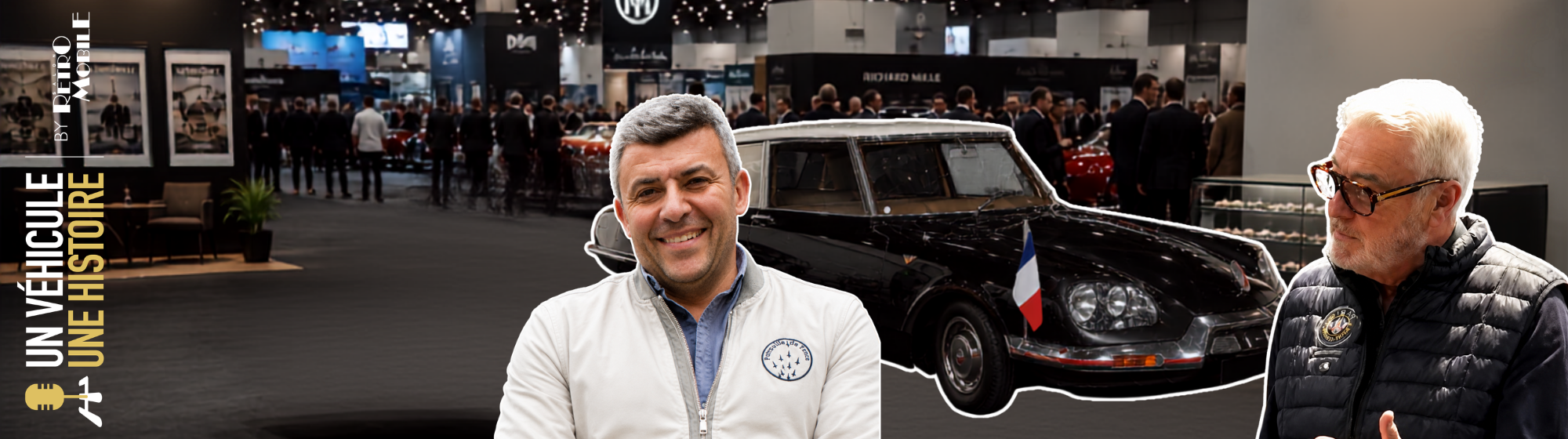
General de Gaulle’s DS 21 Pallas: the most famous ordinary car
There are cars that seem unremarkable at first glance. And that is precisely what makes them extraordinary. Christophe Godineau’s DS 21 Pallas is black, understated, with no visible insignia. On the surface, it is a DS like any other, rolled off the Citroën production lines in October 1965 and registered on the 5th of that same month. In the mid-1960s, a black DS on the streets of Paris was a common sight. No one turned their head. And that was exactly the point.
Because this DS was anything but ordinary. From 1965 to November 1967, it was used by General de Gaulle for his journeys between the Élysée Palace and Colombey-les-Deux-Églises. In its own way, it is a piece of the Fifth Republic. And it was at Rétromobile 2026, at the heart of a DS stand entirely dedicated to presidential cars, that Christophe Godineau told us its story, with the quiet pride of a man who knows exactly what he has in his hands.
Presidential DS: a car of discretion, not protocol
To understand the role of this DS 21 Pallas, one must first distinguish between the two types of vehicles used by the presidency. On one side, ceremonial cars: grand parade limousines, DS ceremonial convertibles, used in very specific situations, in front of crowds and cameras. On the other, working cars: discreet, functional, invisible in traffic.
“When General de Gaulle travelled in this car, he needed a certain level of discretion, unlike ceremonial vehicles,” explains Christophe Godineau. The pennant was not displayed permanently. The cockade was kept away and brought out only when necessary. A black DS in the mid-1960s was an everyday car. The Head of State could return home to Colombey, at least every four days according to his well-known habit, without attracting attention.
It was in this role as an “all-purpose” vehicle that this DS 21 Pallas clocked up its kilometres, between Paris and Haute-Marne, linking the Palace of the Republic with La Boisserie. An intimate journey, far removed from the splendour of protocol.
General de Gaulle’s DS: the small details that make great history
Inside, a few discreet modifications reveal the special nature of this example. Nothing ostentatious, everything functional. “First of all, there is what we call the gun holder,” explains Christophe Godineau: the security officer on board had to be able to protect the General and his wife in any circumstances.
Two sun visors were also installed in the rear compartment, “a special order at the General’s request,” completely absent from the Citroën catalogue, though Citroën nevertheless responded to the presidency’s request. The same applies to the document holders, also custom-fitted: the General worked in the car, put down his files, picked them up again, and continued to exercise power between two bends in the road. The DS was his mobile office, his working space between two places of the Republic.
Everything else is original, identical to any DS 21 Pallas that left the Citroën factories. “It really is a production vehicle,” Christophe Godineau insists. That is precisely its most fascinating paradox: the most photographed car on the DS stand at Rétromobile 2026 was also the most ordinary in its design. History, very often, resides in the details.
Presidential DS at auction: Christophe Godineau against the Élysée
The episode opens with a confession that perfectly captures the spice of this acquisition. “I knew I was bidding against the Élysée.” Christophe Godineau bought this DS remotely, through a sealed-bid auction. “It wasn’t an outrageously expensive vehicle, but it was still a substantial sum.” The Élysée was in the running. It did not go far enough. Christophe did. He snatched the General’s DS from under the Palace’s nose. In the world of collectors, an anecdote like that is worth every certificate of provenance.
What he discovered afterwards, however, was less encouraging. “When I saw the condition of the vehicle, I thought, no, this can’t be possible.” The DS had been stored for years, poorly preserved. Corrosion had done its work, as it so often does on these particularly sensitive bodies. “A DS that doesn’t run, more than any other vehicle, is a DS that deteriorates,” confirms François Allain. The hydraulics, the mechanics: everything required attention that years of dormancy had not spared. It was a wreck. A wreck with an exceptional destiny to fulfil.
Presidential DS: a restoration under pressure, with the Republic as a deadline
Christophe Godineau entrusted the first phase of the restoration to a century-old garage in Charente-Maritime. The estimated timeframe: eighteen months of work. At the same time, he made contact with the GSPR, the Security Group of the Presidency of the Republic, which wanted to display the car during the European Heritage Days. “So I had a deadline facing me. A sword of Damocles.”
The garage fell behind schedule. Staffing issues, delays piling up, and eventually one craftsman left alone with a project that exceeded the planned timeline. “He told me, I’m going to have to ask you for another year. I said, listen, that’s not possible.” Christophe then called the Élysée and reached his contact, Jean-Sylvain, who suggested he get in touch with Atelier des Chevrons, a restoration workshop well known among owners of classic Citroën vehicles.
Initially slightly sceptical at the idea of yet another DS, their reaction changed completely as soon as they learned the car’s history. “The General’s DS? We’ll take on the challenge.” Atelier des Chevrons coordinated the various trades, orchestrated the restoration on time, and the car was completed in 2025, just in time — or almost — to keep the promise made to the presidency.
De Gaulle’s DS: the General’s fabrics, still there
Christophe Godineau’s restoration philosophy is clear, and it says everything about his vision of what it means to own such an object. “My starting point was to preserve as much of the vehicle’s authenticity as possible.” In practical terms, this means that the original upholstery fabrics were kept, cleaned and preserved. A small tear on the driver’s seat backrest received a discreet patch, but the upholstery is indeed the one from the period.
“The General and his wife, Tante Yvonne as people affectionately call her, truly lived their journeys between Paris and Colombey on that very fabric.” This sentence alone sums up the nature of the approach: it was not merely about restoring a car. It was about preserving a tangible, physical testimony to what the Fifth Republic was in its ordinary hours. New tyres, fresh paint, restored mechanics: the functional elements were renewed. But the soul of the car remains intact.
General de Gaulle’s DS: historic monument, guardian of the Republic
From the moment he acquired it, Christophe Godineau had an objective that went beyond simple collecting. “My aim, when I bought this vehicle, was to share the General’s values through it and show it to the public.” To achieve this, and to protect this example in the long term, he began the process required for its inclusion in France’s national heritage.
The process was successful. General de Gaulle’s DS 21 Pallas is now registered as a historic monument. The DRAC commission for the Pays de la Loire region even expressed the wish for it to be classified, a higher level of State commitment to its protection. “This car is a historic monument. It belongs to France. I am only its custodian.” Three sentences that perfectly sum up Christophe Godineau’s position: passionate, but fully aware of the responsibility represented by such an object.
What followed was worthy of that status. The restored car was first received at the Élysée, of course, before crossing Paris under the protection of the Republican Guard. A visitors’ book was opened. Visitors wrote down their memories of the General, their words, their attachment to a figure they consider “one of the essential figures of French life.” It was fabulous, Christophe Godineau says, repeating the word as if saying it once were not enough.
The crowning moment came at Rétromobile 2026, where the DS 21 Pallas joined an entirely presidential stand: alongside the current DS, the SM parade convertible and the special DS ordered by the General for his official journeys, it embodied the most intimate side of Gaullian power. “The most photographed vehicle, and yet the most ordinary,” François Allain sums up. That is the sacred paradox.
DS and French history: a car for future generations
General de Gaulle’s DS 21 Pallas will still be here tomorrow. European Heritage Days, exhibitions at the Élysée, shows such as Rétromobile: “We will certainly see this car again at events linked to the history of the Fifth Republic,” announces Christophe Godineau. That is his commitment, and the one he has made to a heritage that, now, no longer entirely belongs to him.
“Some presidents travelled by scooter, others in a DS. Each has their own style and their own era.” The phrase raises a smile, but it says something essential: the objects of power are also reflections of character. This black DS, without pennant, without insignia, without ostentation, resembles the man who chose it. A great man who liked to return home to Colombey, far from the gilded halls of the Republic, in a car that no one recognised.
Discover General de Gaulle’s DS 21 Pallas and many other exceptional vehicles in Rétromobile’s “One Vehicle, One Story” podcast. To make sure you never miss an episode, visit the Rétromobile website and all streaming platforms.