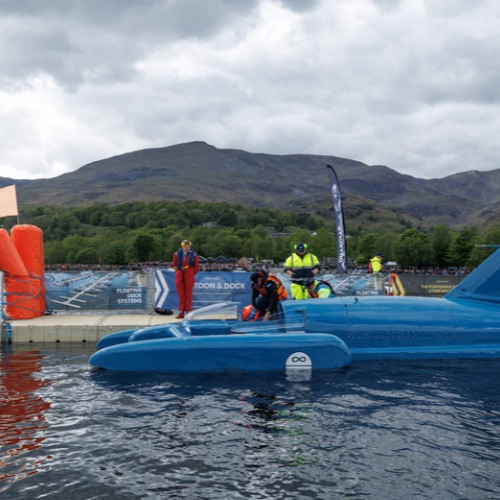
Bluebird K7: the record-breaking bird comes to Rétromobile 2027
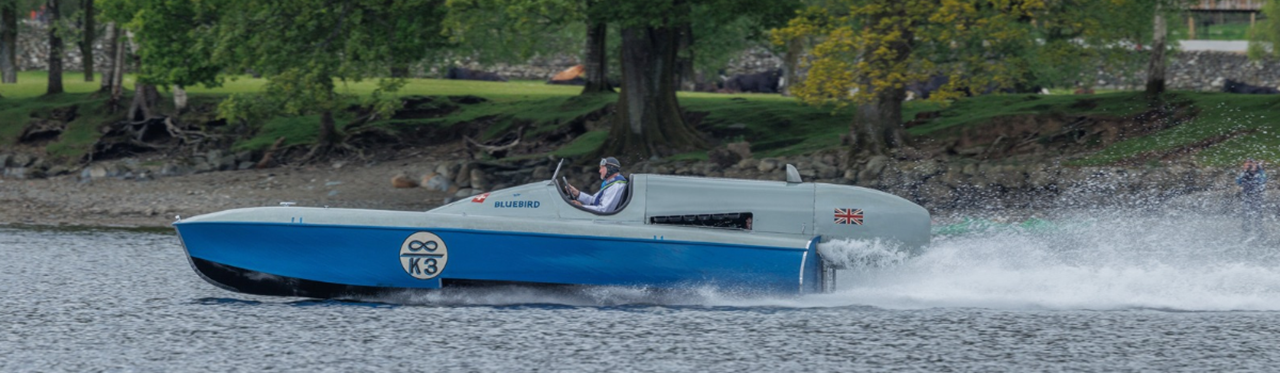
Bluebird K7: a curious bird comes to Rétromobile
Campbell: a line of speed-seeking adventurers
In the Campbell family, driving fast was never enough. The aim was to go faster than anyone else, and sometimes even faster than reason would allow. This obsession spanned two generations and two men, a father and a son, united by the same dizzying pursuit: absolute speed.
Born on 11 March 1885, the Englishman Sir Malcolm Campbell was one of the first to try to tame speed at a time when the automobile was still inventing its own limits. His machines, built for the purpose, featured streamlined bodies and all bore the same name : Blue Bird in tribute to The Blue Bird, the play by Franco-Belgian playwright Maurice Maeterlinck, which he discovered at the Haymarket Royal Theatre. On each bodywork, the magical bird was painted like a talisman. Six cars, four hydroplanes: the legend took shape, record after record.
In the 1930s, Malcolm Campbell, knighted by King George V, achieved one of his most spectacular feats with the monumental Campbell-Napier-Railton Blue Bird.
Malcolm Campbell, from land to water
On 3 September 1935 in Daytona, Malcolm Campbell set a record at 482 km/h. A peak for any driver. But not for him. Land was no longer enough: he now had to conquer water. With a nautical version of his, he set his sights on the world water speed record and, on 19 August 1939, the K4 reached 228.108 km/h.
The war interrupted his momentum. Weakened by several strokes, Malcolm Campbell died at home in 1948, aged 63, leaving behind a name, a myth and an unfinished challenge.
Donald Campbell, inheriting a dream too great
Donald Campbell, born on 23 March 1921, grew up in the vast shadow of his father. His entire childhood was shaped by the feats of Blue Bird. With Léo Villa, Malcolm’s former chief mechanic, he brought the old K4 back out, without ever managing to do better than his father. How do you surpass a legend?
Technology, meanwhile, had moved on. The best pilots were now flirting with 300 km/h on water, and a rival had emerged : John Cobb, who passed 320 km/h aboard the world’s first turbo-jet hydroplane. When Cobb was killed in 1952 during another record attempt, Donald wavered, even considered giving up. Then he changed his mind. It would be him, or no one.
He then poured all his energy into designing a new machine, recognisable by its three aluminium sponsons. Powered by a turbojet, Bluebird K7 was built to reach 400 km/h. Its name came from Lloyd’s Register, where it was recorded as the seventh craft in the Unlimited category. Between July 1955 and December 1964, Donald Campbell set seven world water speed records with this strange bird that looked like a seaplane. Nothing, it seemed, could stop him.
On land too, he now wanted to write his name into the Guinness Book of Records. He designed the Bluebird CN7, at the wheel of which he experienced his first real scare: on the Bonneville Salt Flats, he lost control at more than 580 km/h and crashed, escaping with a fractured skull. Nothing weakened his determination. The CN7 was reborn and set off once again, this time to attack Lake Eyre in Australia. In 1964, Donald Campbell became the only man to hold both the world land speed record and the world water speed record at the same time. An achievement never equalled.
But a man like him never stops in time. 444.7 km/h on water? That was not enough. He wanted to break the mythical 300 miles per hour barrier, 484 km/h, and become, once and for all, the fastest man on water.
4 January 1967: the price of the final record
In early January 1967, Donald Campbell returned to Coniston Water, in north-west England. The Ministry of Defence had loaned him a Bristol Siddeley Orpheus jet engine, and the Bluebird had been fitted with a new stabilising fin. Everything was ready to take on the 300 miles per hour barrier. Only the weather stood in the way, delaying the trials day after day.
On 4 January, the sky finally cleared. During his first attempt, Donald Campbell briefly touched 311 mph (501 km/h). He now had to confirm the performance over one kilometre. Without waiting for the lake to settle, he set off again. He would never return.
As it races at full speed, the engine stalls.Almost immediately, the Bluebird and its pilot shoot vertically into the air before breaking apart as they crash back into the water. The impact was fatal. The craft sank immediately.
First to arrive at the scene was Robinson’s son, whom Campbell nicknamed “Robbie” and whose family ran the local hotel. He would later describe a chilling scene to the local press: “Donald’s gloves, as well as his shoes, socks, life jacket and the teddy bear that never left him, were floating on the surface, among the debris.” Divers from the British Navy located parts of the wreck. Donald Campbell’s body, however, remained missing.
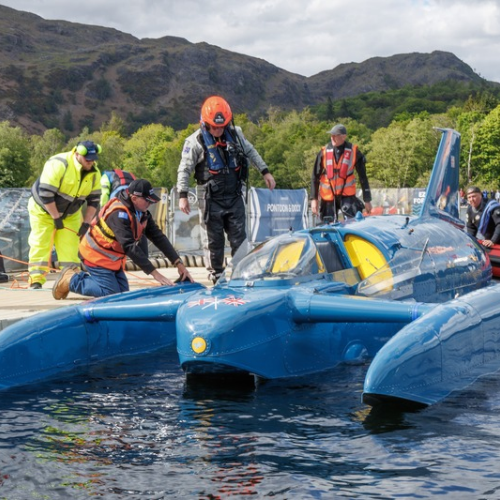
Bluebird K7: a legend brought back from the depths
It was not until 2001 that a team of divers finally recovered the wreck of the Bluebird K7, followed two months later by the body of its pilot. Since then, Bill Smith and an army of volunteers have brought the hydroplane back to life, restoring it exactly as it was. On 11 May 2026, nearly 70 years after Donald Campbell’s first water speed record, Bluebird K7 returned once again to the waters of Coniston during Bluebird K7 Festival.
Prepare your visit
In 2027, 60 years after the death of its pilot, the K7 will cross the Channel to reach Porte de Versailles for Rétromobile. Through an immersive scenography combining archive footage and personal objects, visitors will be able to (re)discover the unique story of this record-breaking legend and the bond that connects it to the Campbell family.