[EXHIBITION] Mob' in France: the moped hits the road again at Rétromobile!
Mob' in France: the moped celebrated at Rétromobile 2027
Mobylette: the birth of a French icon, courtesy of Motobécane
Although the moped went on to become a French icon, it was born in a far bleaker context: postwar France. As the country was healing its wounds, French men and women alike were craving one thing above all: the freedom to move around. While Renault was working on the 4CV and Citroën on the 2CV, it was in the two-wheeler world that one of the century's greatest popular successes quietly took shape.
In October 1949, at the Paris motorcycle show, an odd-looking machine sat tucked away in the back room of the Motobécane stand. The Pantin-based manufacturer hesitated to even display it. It took a journalist, Max Ender, to bring it into the spotlight, publishing a glowing write-up in the magazine Motocycle. Designed by Charles Benoît and engineer Éric Jaulmes from a reinforced bicycle frame and a 49.9cc engine, the machine looked like nothing else on the market. It was named "Mobylette," a blend of "mobile" and "bicyclette" (bicycle).
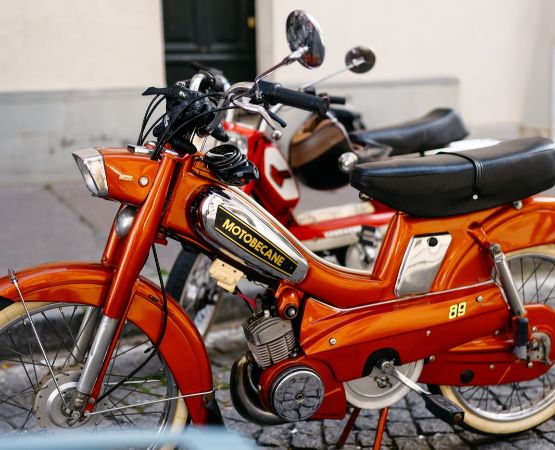
Neither a bicycle nor a motorcycle, the Mobylette AV3 quickly earned its place: an open frame accessible to both men and women, a belt-drive transmission (first mocked by competitors, later widely copied), and a top speed of around 17 mph. Priced at 36,000 francs (remarkably affordable for the time), it gave millions of French people an unprecedented sense of freedom. The one-millionth unit rolled off the line as early as 1955, prompting Motobécane to open a new factory in Saint-Quentin.
At the dawn of the 1960s, the brand struck again with the AV88, nicknamed "la bleue" for its azure livery. A rear swingarm suspension brought unheard-of comfort, making it the best-selling moped in the world. At its peak in 1974, the factory in Picardy was producing one unit every seven seconds, 750,000 a year. In total, Motobécane sold 14 million units before filing for bankruptcy in 1983.
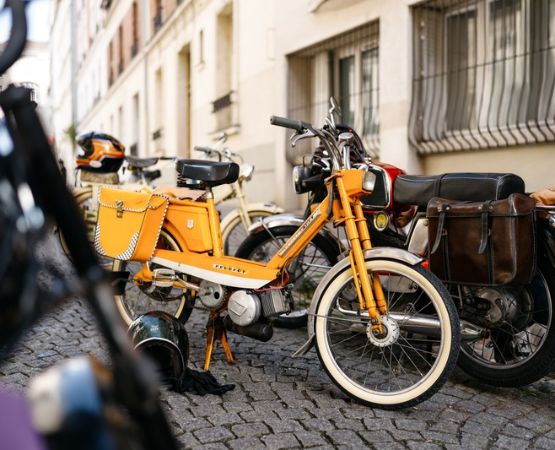
Peugeot 103, the other face of the moped
The moped, a rite of passage across generations