
Volvo: 100 Years of Automotive Innovation Take Centre Stage at Rétromobile!
1927-2027 : Volvo, 100 ans d'héritage Suédois.
There's a little Volvo in every car. And in 2027, there will be a lot of Volvo at Rétromobile!
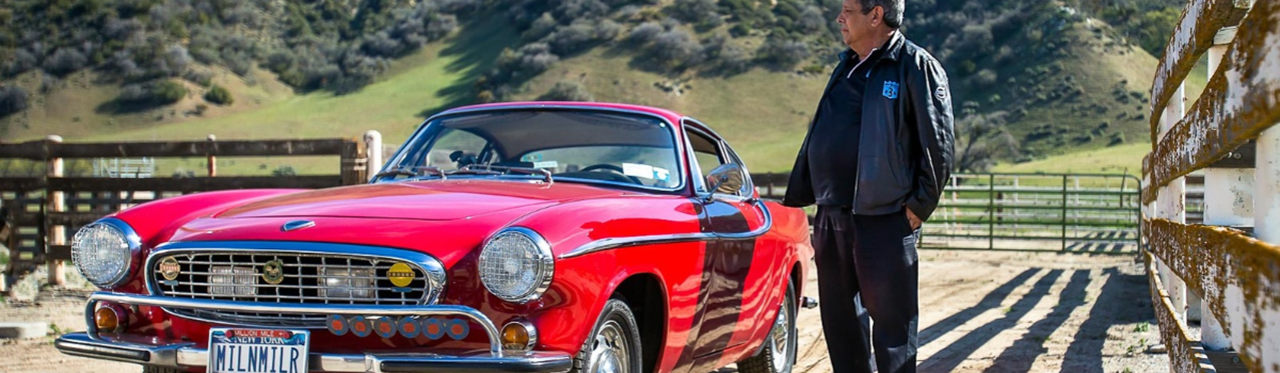
To mark the brand's centenary, Rétromobile will host, from 3 to 7 February, a unique retrospective dedicated to the Swedish manufacturer. Located at the heart of Pavilion 4, this exhibition will retrace 100 years of innovation through some of the most iconic models produced by the Gothenburg firm. Volvo ÖV4 "Jakob," 245 Turbo redesigned by Hermès, and of course the legendary 1800S once owned by Irv Gordon: these are just a few of the emblematic models to be discovered as part of this showcase.
Origins of Volvo: a philosophy built on safety
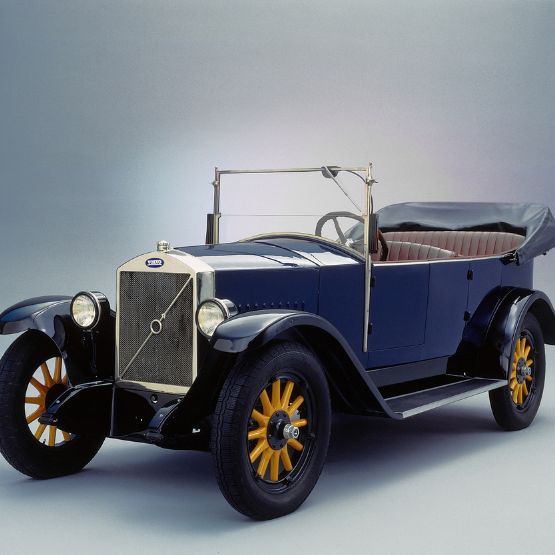
On the morning of 14 April 1927, the very first production Volvo rolled out of the factory. Named the ÖV4 and nicknamed Jakob, it left the factory... in reverse! Hastily finished the night before its launch, the car ended up with it's transmission mounted backwards. This mishap did nothing to hinder the ÖV4's early career, it's grille bearing the ancient chemical symbol for iron, a nod to the legendary robustness of Swedish steel.
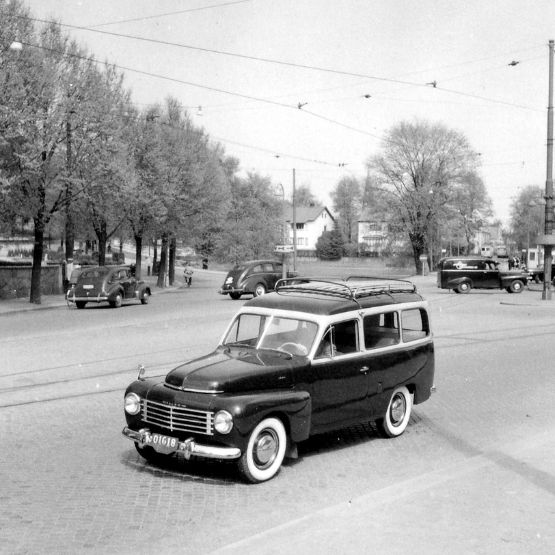
At the time, paved roads were rare, and Gustav Larson already regarded safety as a matter of survival, prompting him to test the ÖV4's resistance to rollovers. The 1929 crisis slowed the brand's development, leading it to diversify its production into trucks, taxis, buses, construction engines, aircraft engines and, from 1930, the Penta marine engines it acquired that year. It was not until the first deliveries of the PV144 in 1947 that car sales began to rise, overtaking truck sales two years later. Production of the PV144, slowed by the post-war steel shortage, led to early second-hand examples reselling for twice the price of a new one. Its modern monocoque chassis was already presented as a protective cell for driver and passengers, a concept that would set the standard, much like its laminated windscreen, a world first that would not become mandatory for all cars until 1983.
Seatbelt, child seat, headrest: Volvo invents modern safety
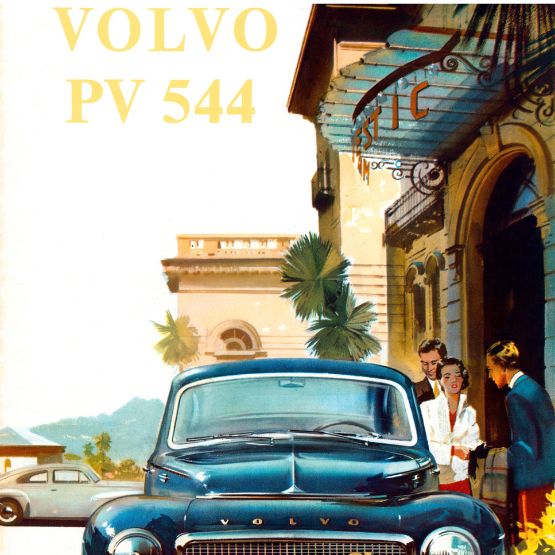
Over time, Volvo cars were fitted with an ever-growing number of innovative safety solutions, starting with the three-point seatbelt. Introduced in 1959, it would go on to save millions of lives. Its invention is credited to engineer Nils Bohlin, recruited from Saab Aviation, where he had previously developed ejector seats: working in reverse this time, he devised a system designed to hold the driver firmly in their seat in the event of a collision. The P120 Amazon and PV544 were the first Volvo models fitted with this new device. In 1967, a two-point belt was introduced for rear seats. In 1968, Volvo added the now-essential headrest. A year later, the brand introduced the retractor for front seats, followed by rear seats in 1972. Made mandatory in France in June 1973, the seatbelt reduced road fatalities by 30% within six months.
"I want to break free": the saga of the Volvo estate
Rétromobile will present the 245 Turbo once owned by former Hermès president Jean-Louis Dumas. Its tan leather interior was entirely reworked by the saddlers of the famous house on Rue du Faubourg Saint-Honoré, the vehicle serving as a showcase for Hermès' craftsmanship.
The iconic 240 series shared its final years on the market with the 700 series. Launched in 1985, it introduced a move upmarket, eventually receiving the celebrated PRV V6 engine, developed in partnership with Peugeot and Renault. The range expanded further in 1990 with the luxurious 900 series, notably the 960, which finally received a modern multi-link rear axle. 1991 marked another turning point with the launch of the 850, promoted with the slogan "the most Mediterranean of Swedes." This first front-wheel-drive Volvo was also offered in a sporty R version with all-wheel drive. In 1996, a partnership with Mitsubishi gave birth to the compact V40, while the 850 evolved into the V70 and the 960 into the V90.
P1800: a Swedish icon shaped for Irv Gordon's hands
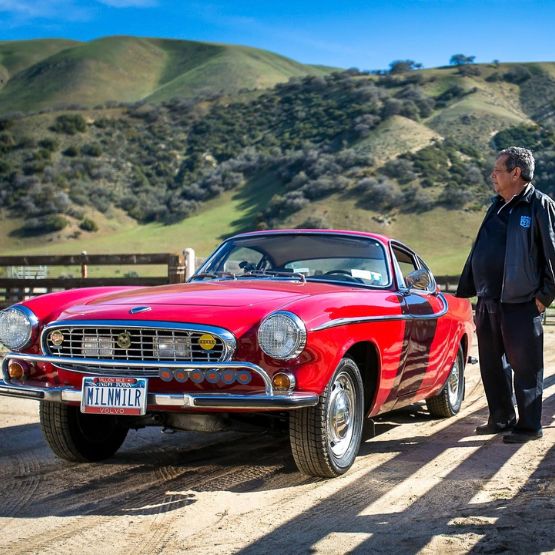
Today, the star of the P1800 line is the 1966 P1800S model owned by American Irv Gordon. So taken was he with his purchase that he drove his coupé some 1,500 miles (2,414 km) non-stop in the 48 hours following its purchase. Averaging 200 kilometres a day on his commute, the science teacher's P1800S had clocked over 804,000 km after ten years. Twenty-two years later, in 1998, the red coupé entered the Guinness Book of Records for the highest mileage driven by a single owner in a passenger car, with 1.69 million miles (2.719 million km) on the odometer. That was only a milestone: in 2002, Irv Gordon crossed the two-million-mile mark, still on the original engine (the sturdy 1.8-litre four-cylinder producing 90 hp, shared with the Volvo Amazon P120), in Times Square, drawing the attention of the international press.
The teacher then set himself a new challenge: reaching three million miles before his 73rd birthday.
"In my opinion, whether or not I reach that goal will depend more on me than on the car. The car's components have long since proven they can do it, but I can't say the same for mine. Either way, it will be a fantastic testament to the ingenuity of Volvo's engineers, but also a fine proof of endurance for people my age," he declared. His new record was achieved in September 2013: the Long Island native crossed the three-million-mile mark in Alaska, on the Seward Highway, along Turnagain Arm, a region he had never visited before. When Irv Gordon passed away in November 2018, his Volvo 1800S read exactly 3,260,257 miles, or 5,246,875 kilometres.
Now on display in the event space “World of Volvo” in Gothenburg, Gordon's red P1800S will be the star of Volvo's centenary celebrations at Rétromobile.
The elegant P1800's career spanned ten years, ending with a superb shooting-brake variant, the 1800ES, with its glazed tailgate. This distinctive styling detail was revived in 1986 on the small 480 ES coupé, which also featured a pair of pop-up headlights. In 1997, forty years after the ill-fated P1900 roadster, of which only 67 examples were built, Volvo returned to open-top motoring with the launch of the C70 convertible, which, twelve years later, became a retractable hardtop coupé-convertible. The coupé and convertible line came to an end in 2012. But the 2009 compact C30, with its echoes of the 1800ES, kept the spirit alive until 2013.
Volvo today: between safety and technology
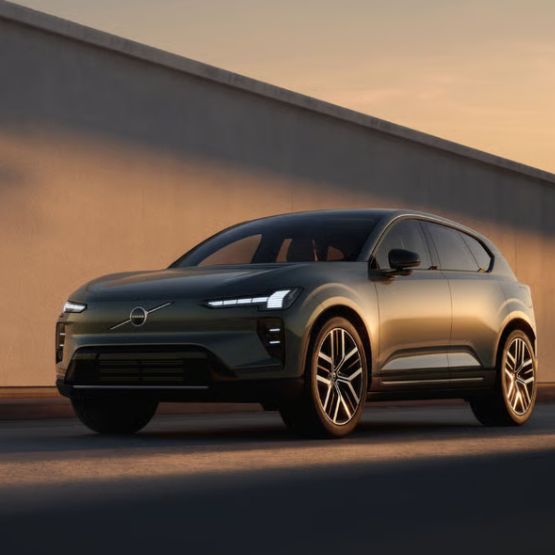
Coupés are no longer part of the current range: the SUV is now the body style of choice. Volvo made the leap in 2002 with the XC90, then confirmed the shift in 2008 with the XC60, which quickly became the Swedish brand's best-seller. Since 2010, the brand has belonged to the Chinese group Geely, which has given it the means to pursue its technological ambitions, particularly in assisted and autonomous driving: as part of the Drive Me project in 2016, Volvo entrusted around a hundred Gothenburg residents with prototypes fitted with semi-automated driving systems.
A hundred years after its founding, Volvo continues to drive for safety: its latest model, the EX60, introduces, as a world first, front seatbelts that adapt to each passenger's body shape. A constant commitment since 1927, to be celebrated at Rétromobile, from 3 to 7 February, in Pavilion 4, through around ten iconic models from this century-long adventure.